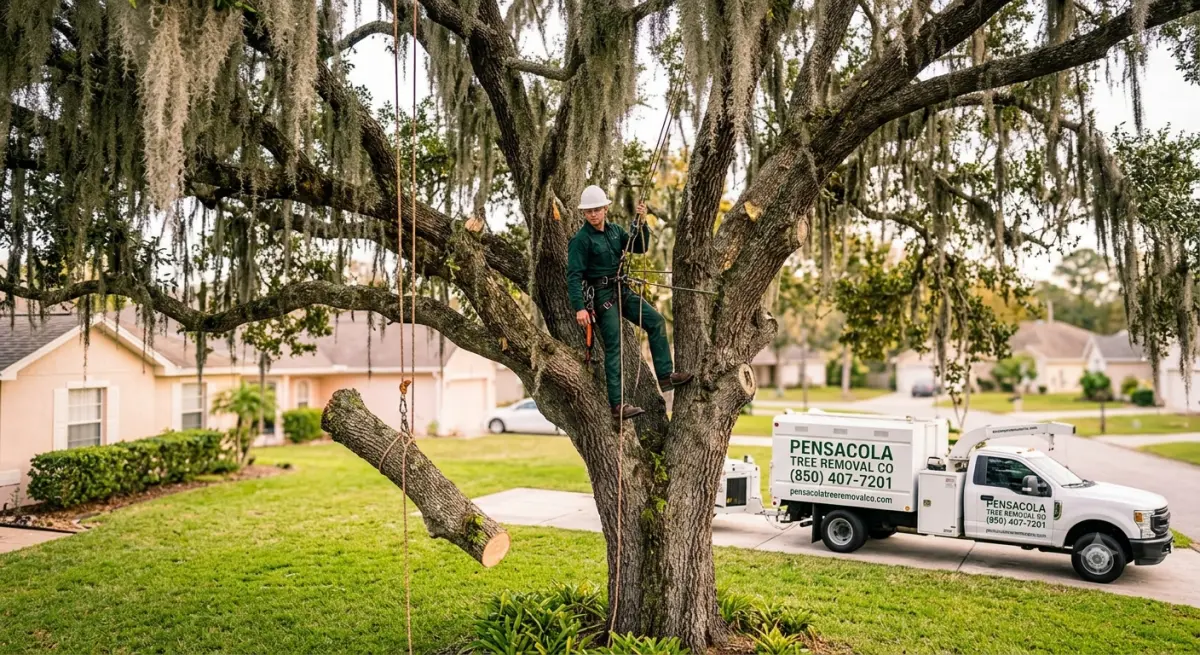
Tree Service Pensacola FL — Pensacola Bay Area
Tree removal, trimming & stump grinding — free estimates, 24/7 emergency response.
Based in Pensacola, we serve the entire Gulf Coast tri-county area. We handle everything from routine trimming to emergency storm response, with free on-site estimates and no pressure.
Pensacola Tree Removal Co connects callers with local pros serving the entire Gulf Coast tri-county area, handling everything from routine trimming to emergency storm response with free on-site estimates.
Pensacola tree work prices by job type and tree size rather than by the hour. Removal runs $400 to $2,500 for most homeowners, averaging $1,100 to $1,400; trimming and pruning are cheaper, with published Pensacola averages of about $107 for a small tree, $396 for a medium and $872 for a large one; and stump grinding is priced separately at $150 to $500 per stump, typically $250 to $350. LawnStarter puts local removal averages at $301 small, $784 medium and $1,843 large, which brackets the same numbers from a different direction. What decides your figure is size first, then access, then what happens to the wood: a job where the crew hauls everything away prices above one where you keep the logs. Ask for removal, stump and hauling as separate lines so the quote is comparable.
Cost figures cited from LawnStarter and national averages reported on r/homeowners. Published market data for reference, not a quote for a specific property.
Mature trees should be inspected every 3 to 5 years, and on the Gulf Coast the calendar that matters is hurricane season. Pruning done before June rather than after a storm is both cheaper and more effective: a crown that has been thinned lets wind pass through instead of acting as a sail, and the limbs that fail in a storm are overwhelmingly ones that were already dead or weakly attached. Live oaks and laurel oaks, both common across Escambia County, differ sharply here — live oak is among the most wind-resistant species in the region while laurel oak is among the least, and a mature laurel oak near the house warrants a shorter inspection interval on that basis alone. Salt exposure and sandy soils closer to the water also affect root anchorage.
Warning signs you should not wait on: deadwood in the upper canopy, limbs over the roof, fungal brackets or mushrooms at the base, cavities where limbs were removed, and roots visibly lifting out of sandy soil on one side. Have it looked at without delay for a tree leaning noticeably more than it did last month, fresh cracks or heaved soil on the ground at its base, or a split where two trunks meet. Those mean the tree is actively failing and the yard under it should be kept clear until it is looked at.
Compare tree service companies in Pensacola on four things rather than on the estimate total. First, insurance: request liability and workers compensation certificates directly from the insurer, because this is the trade where an uninsured accident becomes your problem. Second, scope: whether wood, brush, stump, and cleanup are included or extra. Third, method: how a tree near a structure will be rigged, and whether equipment can reach it. Fourth, timing: a real date, particularly during storm season when schedules slip. Ask all four of each company and compare the written answers. A quote that is far lower usually excludes stump, hauling, or both. Ask each company who supervises the crew on site and whether that person is the one who quoted the job, because the estimate and the work parting ways is where most disputes start.